Guidance towards successful R&D and Innovation

V. Govindarajan & C. Trimble 2010: The other side of innovation – solving the execution challenge

Through the analysis of various industrial cases, the authors extract and describe major recommendations for successful innovation projects. These recommendations are reflected in the chapters of the book and complemented by assessment tools providing critical questions for planning or analysing innovation activities. Providing generally accepted principles of Project, Innovation and R&D Management, the authors underline these with an impressive number of industrial cases and translate these principles into relatively concrete recommendations. The following recommendations create the baseline for the table of content:

1) Build the Team
– Divide the labor.
– Assemble the dedicated team.
– Manage the partnership.

2) Run a Disciplined Experiment
– Formalize the experiment.
– Break down the hypothesis.
– Seek the truth.

By providing the underlying case studies on the Internet (theothersideofinnovation), the credibility of the authors can hardly be topped. This book is recommendable for all, who like straightforward messages underlined by numerous (different) industrial examples.

J.M. Morgan & J.K. Liker 2006: The Toyota product development system – integrating people, process, and technology

Lean development is nowadays a well established method to increase the productivity of R&D departments. Despite some problems in recent times, Toyota still represents the shining example and the reference for any other company using this method. The authors underline the principles of lean development through practical examples from Toyota and the comparison with the U.S. automotive industry. The overall book is based on their recommendations towards successful product development which is reflected in the table of content:

1) Process Subsystem
Establish customer-defined value to separate value-added from waste.
– Front-load the product development process to explore alternatives thoroughly.
– Create a leveled product development process flow.
– Utilize rigorous standardization to reduce variation and create flexibility and predictable outcomes.

2) People Subsystem
Create a chief engineer system to lead development from start to finish.
– Organize to balance functional expertise and cross-functional integration.
– Develop towering technical competence in all engineers.
– Fully integrate suppliers into the product development system.
– Build in learning and continuous improvement.
– Build a culture to support excellence and relentless improvement.

3) Tools and Technology Subsystem
Adapt technology to fit your people and process.
– Align your organization through simple, visual communication.
– Use powerful tools for standardization and organisational learning.

This book is a great handbook on the principles of lean development including descriptions of various tools and techniques such as value-stream mapping,  A3 problem solving  and integration mechanisms. It is worth reading for all who want to get inspirational insights on how to improve product development underlined by industrial examples from the manufacturing (automotive) industry.

Recommendations on how to design the organisation and process structure of R&D and Innovation are becoming more and more common in management literature. They can be the source of great inspiration for improvement and are credible due to the link to „real“ industrial case studies. However, the major challenge lies in the identification of the tools and techniques that work in the own company and finally in leading these tools and techniques towards successful implementation.

Sven Schimpf

Adopting Disruptive Innovation

We’re all familiar with the Ansoff Matrix, from Igor Ansoff, „The Father of Corporate Strategy.“  This broadly-used model for corporate strategy planning has been subtly iterated since its first publication back in 1957, as pace-of-change- and level-of-sophistication of business have increased. Now it’s most-commonly used in the below form, to help companies understand their existing portfolios, help plan where they can realistically extend and help think about how to build completely-new areas of business.
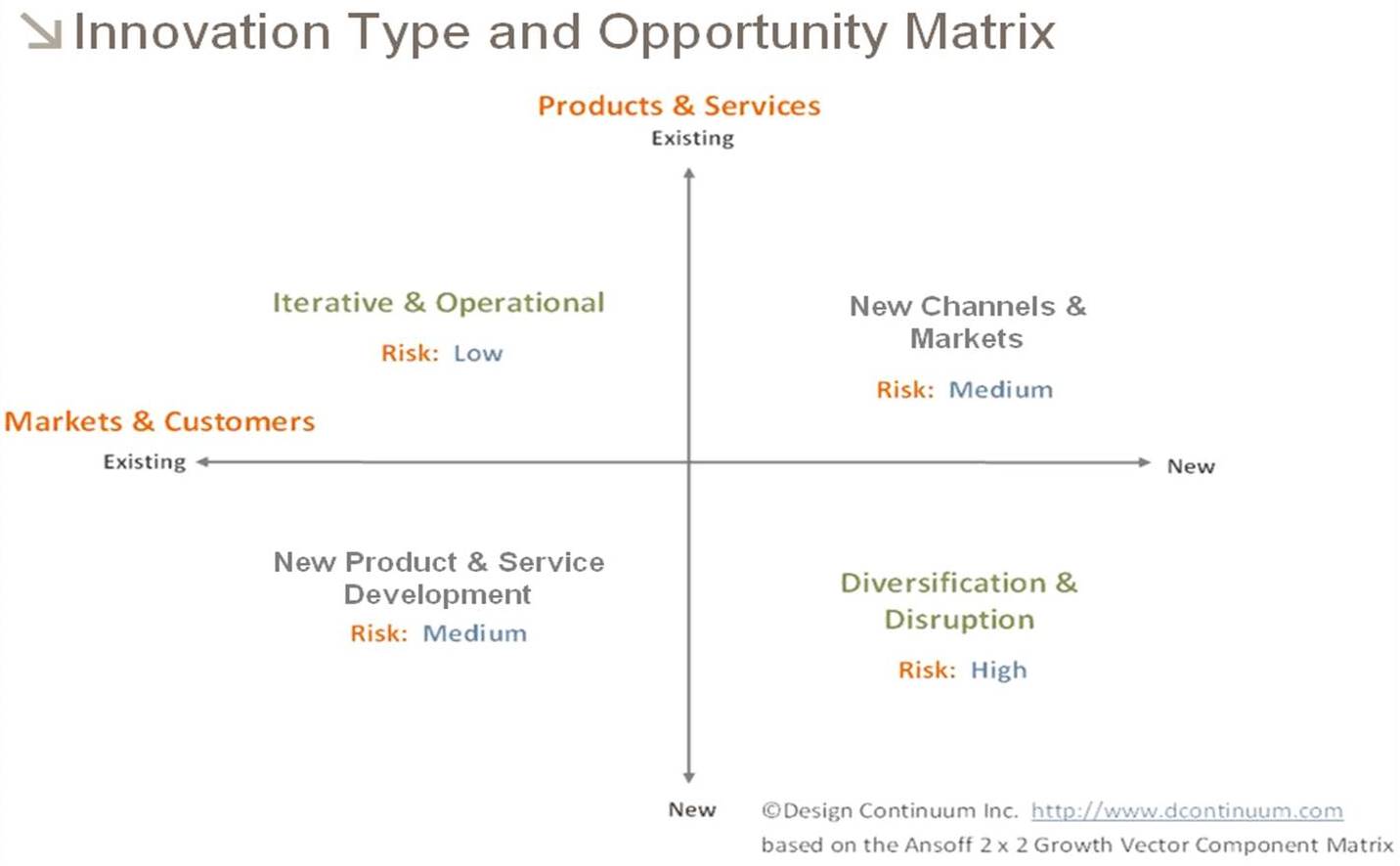
Innovation Type and Opportunity Matrix

Most Firms now have a portfolio of R&D and Innovation investments, placed across these quadrants, with the grouping depending on their growth planning and tolerance for the various risks in each quadrant.

It’s probably fair to say that every company aspires for a big win in the “New Markets & Customers / New Products & Services” quadrant, but investment there is most-risky and outcomes can be most disruptive to company cultures, existing markets and existing business models.

For most companies, the main barriers to success in the “new / new” quadrant are modeling outcomes, building intermediate project metrics and justifying investments. Projects in this quadrant are the most-likely to be stopped, because the initial business models that have been developed often appear much-weaker than those of competing project investments in other quadrants of activity.

Usually, it’s the high risk in investing in the first few steps that kills a disruptive innovation project in its infancy—costs seem out of scale to the opportunity, level of resource commitment is usually very high, there can be disruptions to present business and time-to-profitability is uncertain.

The question that has often been posed is how companies can “let something grow a little longer,” before making a decision about its fate. Every company wants the growth that disruptive innovation brings, but they lack the tools to plan for it and measure its progress.

The Backcasting model is very powerful for planning investment in disruptive innovation. Using this tool, companies can envision a desired future, then plan backward to the present, making reasonable assumptions about evolving capabilities, resources and business conditions. Articulation of credible project stages and goals allows more-informed decisions about project trajectory, at each stage of its implementation.
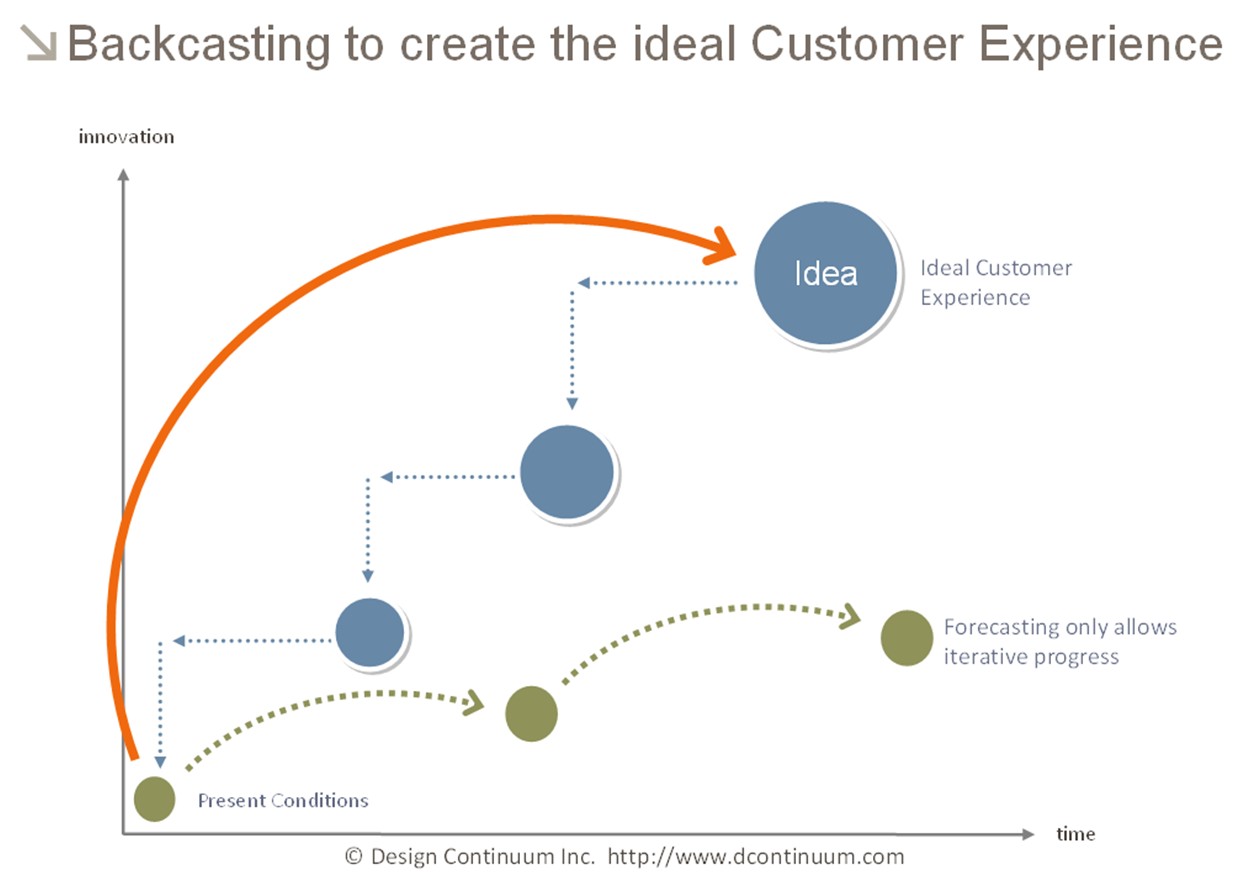
This method differs from forecasting, since forecasting depends on assumptions of reasonable growth from existing conditions, based on historical performance and some “feel” from the forecaster. Forecasting can only ever be iterative, while Backcasting is used to build a roadmap, with checkpoints and metrics, to a completely-new future state.

Mark Zeh

Strategien für technologieintensive Unternehmen in Zeiten des Wandels

Das Fraunhofer IAO veranstaltet am Mittwoch, 1. Juli 2009, in Kooperation mit Tantum, ein Abendsymposium für technologieintensive Unternehmen.
Ziel ist es zu zeigen, wie globale Unternehmen auf die Herausforderung des nachhaltigen Wachstums reagieren können. Dies wird anhand des praktischen Beispiels der Firma Embraco in Kooperation zwischen dem Fraunhofer IAO und Tantum dargestellt.
Informationen zu Programm und Anmeldung sind im Internet auf der Webseite des Fraunhofer IAO zu finden.

Ansprechpartner:
Flavius Sturm
Nobelstraße 12, 70569 Stuttgart
Telefon +49 711 970-2040, Fax +49 711 970-2299
flavius.sturm@iao.fraunhofer.de

Weitere Informationen:
Veranstaltungsseite am Fraunhofer IAO

Sven Schimpf